
A gunman shot and killed three kids and a trainer at a school in Bend, Oregon, on Oct. 15, 2026, the 52nd school shooting this year, in line with CNN. The youngsters’s ages have been 5, 8 and 11; a 7-year-old and one other trainer have been taken to the hospital with essential accidents. The 16-year-old taking pictures suspect was shot and killed by a bystander.
Although Oregon has stricter gun laws than most states, a few of these legal guidelines, equivalent to a measure requiring harder background checks and requiring an individual to have a allow with the intention to purchase a gun, are stalled in courtroom.
The Bend taking pictures – the newest in an extended line of contemporary college shootings courting again to the late 1980s – comes simply weeks earlier than the midterm elections, during which voters will select members of Congress and state lawmakers who can form gun legal guidelines.
Practically 50 million Americans ages 18 to 29 are eligible to vote within the upcoming midterm elections, and about 60% say they plan to. In the event that they comply with by, it might break midterm turnout information for voters below 30.
Gun control is a matter these younger voters care about greater than the general public at giant does, and it’s simple to grasp why: Of their lifetime, mass shootings have been a recurring part of American life.
Immediately experiencing a mass taking pictures is uncommon, but some younger individuals have survived two earlier than turning 25. When a gunman opened fireplace at Brown College in December 2025, at least two students on campus had already skilled a faculty taking pictures earlier than they received to school. The identical factor occurred in April 2025, when college students who lived by the 2018 Parkland, Florida, shooting at Marjory Stoneman Douglas Excessive College discovered themselves caught in one other taking pictures at Florida State University. As one of them put it: “That is America.”
Researchers have known as today’s young adults the “bloodbath technology.” They’re the primary group to develop up totally within the post-9/11, post-Columbine High School shooting era, with routine lockdown drills, heightened security in schools and nonstop media coverage of mass violence.
As criminologists who examine the impacts of victimization and gun violence amongst young people, we wished to understand how rising up with the specter of mass shootings has formed younger adults’ views on gun laws. In a recent study, we surveyed practically 1,700 younger adults, ages 18 to 29, throughout the nation to search out out. We discovered that worry of mass shootings pulls this technology aside alongside political and gender traces: It pushes some towards wanting stricter gun legal guidelines and others in the other way.
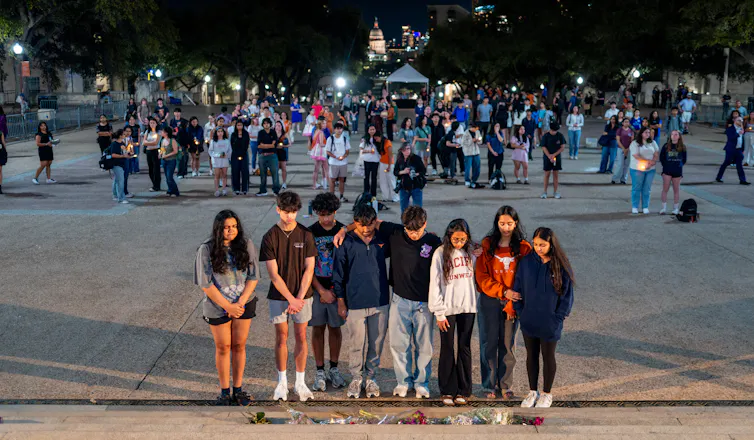
AP Photo/Joe Kline
A debate that repeats after each taking pictures
Mass shootings account for about 1% of gun deaths within the U.S. Nonetheless, they profoundly form how secure tens of millions of Individuals really feel. In a 2019 survey by the American Psychological Association, practically 80% of Individuals mentioned the potential of a mass taking pictures confused them out, and a 3rd mentioned they avoided certain places because of it. The worry has turn into so widespread that clinicians now have screening tools to evaluate and deal with individuals with anxiousness over mass violence.
Younger adults have additionally grown up watching the identical heated gun debates play out after each tragedy. Gun control advocates name for stricter firearm restrictions to forestall the next mass shooting, whereas gun rights advocates push again with the “good man with a gun” argument, a phrase made popular by the National Rifle Association. Supporters of the latter view say extra armed residents are wanted to cease energetic shooters, so extra individuals ought to be capable of purchase and carry weapons with fewer restrictions, equivalent to carrying in public without a permit or on college campuses.
Researchers have recognized for a very long time that more guns don’t necessarily mean less violence. A 2021 study discovered that mass shootings have been extra widespread in states with larger charges of gun possession, and gun homicides have been extra widespread in states with looser hid carry legal guidelines. But even after decades of mass shootings, federal gun coverage has barely budged. Even the place particular person states and native governments have handed assault weapons bans, together with Connecticut and Cook County, Illinois, they’ve confronted Second Amendment challenges that are now before the Supreme Court.
Younger individuals have turn into among the loudest voices in this debate, most notably by March for Our Lives – a company began by Parkland survivors that focuses on ending gun violence – and other youth-led groups throughout the nation. And since pro-gun views are usually extra widespread amongst older Americans, many political observers assume stricter gun laws will follow as younger individuals gain voting power.
This fall, voters in a couple of states will weigh in on gun coverage straight.
In Massachusetts, voters will determine whether or not to keep or repeal a 2024 law that, amongst different issues, requires gun house owners to register their firearms with the state, expands security coaching for individuals making use of for a gun license and broadens the state’s ban on assault-style weapons. In Arkansas, they’ll determine whether or not to change the state constitution to extra strongly defend gun rights, together with the precise to personal ammunition and gun elements. If younger adults prove in document numbers, their views may assist decide outcomes like these.
Brandon Bell/Getty Images News via Getty
Younger adults are cut up
So the place do younger adults stand? We’ve discovered {that a} shared worry of mass shootings doesn’t essentially result in shared views on weapons. Our survey asked younger adults to fee on a scale from 1 to three – from “under no circumstances” to “rather a lot” – how a lot they worry that they or somebody they love will turn into a sufferer of a mass taking pictures. Greater than 60% reported reasonable or excessive ranges of worry, together with about 17% who fell within the high-fear vary.
Basically, about two-thirds of younger adults mentioned individuals ought to want a allow to hold a gun in public and that weapons shouldn’t be allowed on school campuses. About 6 in 10 disagreed that proudly owning extra weapons makes individuals safer, and an identical share disagreed that gun management legal guidelines are unconstitutional.
We discovered that younger adults who apprehensive extra about mass shootings tended to be extra supportive of gun management. However this sample didn’t maintain for younger males, Republicans or those that have been politically conservative. For these teams, the alternative was true: The extra they feared mass shootings, the much less they supported gun restrictions. Younger adults are divided on gun management, and people divisions are sharpest when worry runs excessive.
Within the coming years, the bloodbath technology is on observe to turn into a part of the largest voting bloc in the country. Most younger adults share a worry of mass shootings, however they disagree on what to do about them. And with every new mass taking pictures, that divide might solely deepen.
That is an up to date model of an article initially revealed on Oct. 15, 2026.