
Curious Kids is a sequence for kids of all ages. When you’ve got a query you’d like an professional to reply, ship it to CuriousKidsUS@theconversation.com.
What was the primary animal on Earth? – Keira, age 10, Eugene, Oregon, and Julian, age 7, South Bend, Indiana
Think about climbing right into a time machine and setting the dial for when the very first animal was alive. You would want to journey actually, actually far again in time.
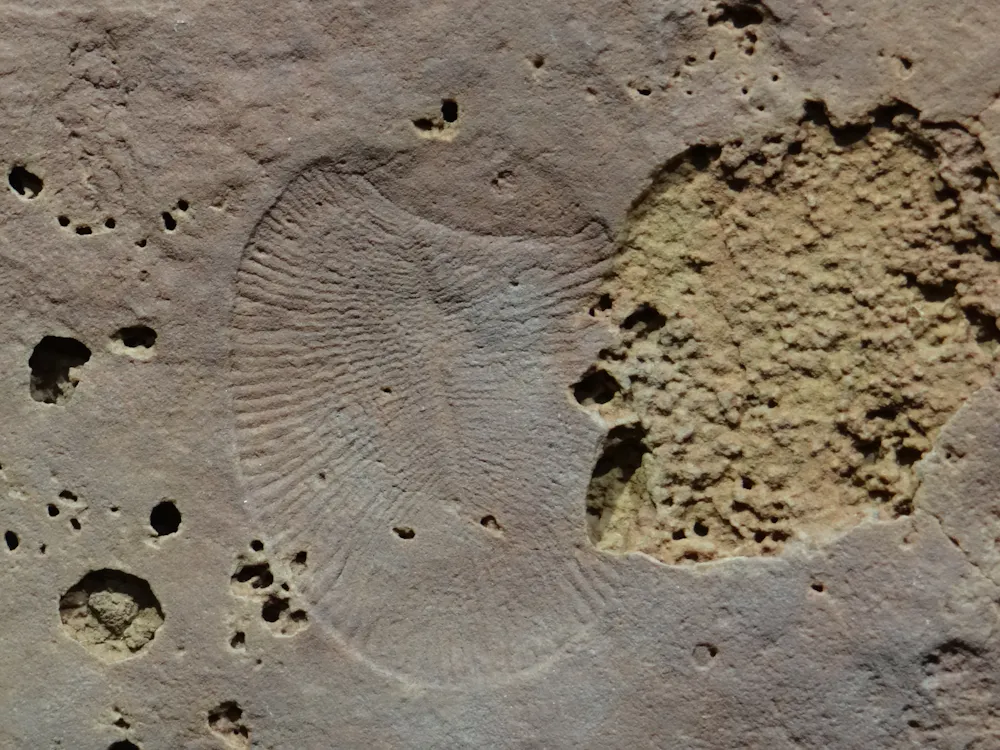
You’d blow previous the dinosaurs, which showed up about 230 million years ago. Preserve going and also you’d move coil-shelled ammonites that swam within the oceans beginning 450 million years in the past, after which trilobites, armored animals that scuttled throughout the seafloor greater than 520 million years in the past. Additional nonetheless, round 558 million years in the past, you’ll meet Dickinsonia, a tiny, flat, ribbed oval only some millimeters thick that appears extra like a squashed pancake than any animal .
And even Dickinsonia was virtually definitely not the primary animal.
We are biologists who study single-celled life referred to as protists. How advanced life corresponding to human beings confirmed up within the first place is among the main questions in our area.
Actually, no one can identify the primary animal, however there are numerous clues about what it was most likely like.
What makes an animal an animal?
If we requested you what an animal is, you would possibly say one thing that strikes, eats and reproduces. The difficulty is that loads of nonanimals do all three.
As an example, single-celled amoebae crawl, hunt and swallow their prey entire – and they don’t seem to be animals in any respect!
Biologists define an animal as an organism made from many cells that stick collectively, talk and divide up the work of rising, consuming and shifting. Various kinds of cells specialize to do totally different jobs, they usually all work collectively as one organism. And when animals eat, they absorb outdoors materials as an alternative of constructing their very own meals from daylight the way in which vegetation do.
Discover what shouldn’t be on that record: Legs. Eyes. A mind. A mouth. That issues for what comes subsequent.
Take into account the ocean sponge
SpongeBob SquarePants is a cartoon model of an actual animal, the sea sponge. Actual sponges don’t put on sq. pants; they don’t even transfer round. They sit anchored to the seafloor, pumping seawater by means of 1000’s of tiny holes and straining out micro organism to eat. They’ve no brain, no heart and no muscles.
However sponges are nonetheless animals, and scientists usually consider them as the best ones. A part of what makes them so attention-grabbing is a sort of cell they’ve called choanocytes. Every choanocyte has a whiplike tail ringed by tiny fingerlike projections that lure meals.
Choanocytes look virtually precisely like choanoflagellates, free-living, single-celled organisms which might be the closest living relatives of animals. Watching a colony of choanoflagellates feed collectively is about as shut as you may get to seeing the doorway between single-celled life and animal life.
Or had been comb jellies first?
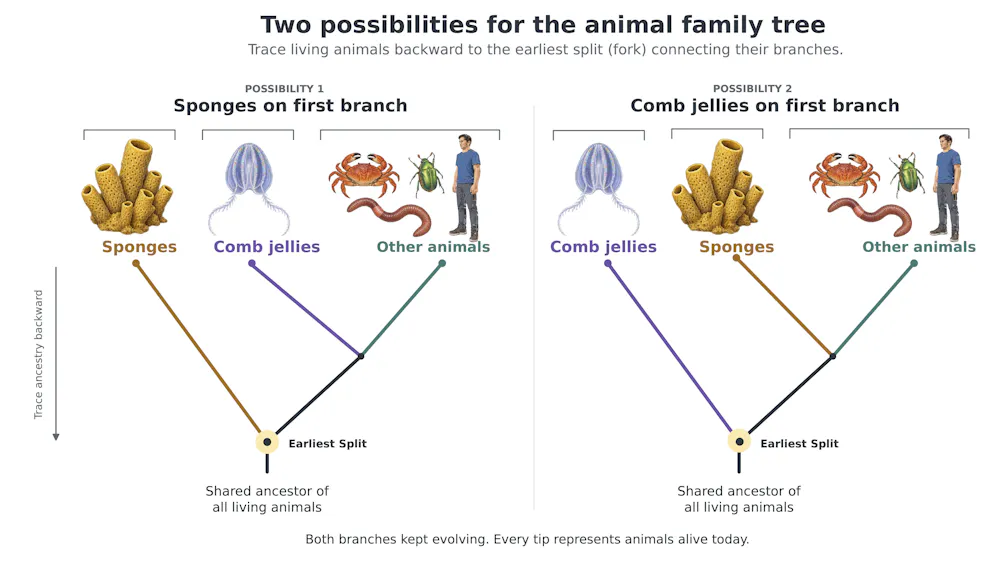
Think about climbing down the animal tree of life going backward in time. You can begin with animals alive at present, which might be the leaves of the tree. Branches be a part of the place you encounter ancestors shared by totally different teams. Comply with them far sufficient, they usually all meet at a common ancestor of living animals. Scientists disagree about which teams belong on all sides of that deepest branching level.
Matthew W. Brown
Some research put sponges alone on one side of that fork, with each different dwelling animal group, together with us, on the opposite. Different research put comb jellies in that position. In that case, these shimmering, jellylike ocean swimmers would occupy one aspect, whereas sponges and all different animals would occupy the opposite. That is what scientists imply after they describe both group as having “branched off first.”
You will need to do not forget that “branched off first” doesn’t imply “unchanged.” Sponges, comb jellies and people have all been evolving for the same amount of time, since our shared ancestor lived. Every lineage has adopted its personal evolutionary path, which over time has led to the good range of animals we see at present, corresponding to worms, bugs, crabs and primates. As we speak’s sponges and comb jellies could due to this fact look very totally different from that frequent ancestor, making it troublesome to image what the primary animal seemed like.
What sorts of proof inform the story?
Comparative biology can take us solely up to now.
cprevot/Wikimedia Commons, CC BY-SA

Fossils are one other supply of data, however they present only a very slender window into the previous. Fossilization turns living material into stone, a course of that works much better on exhausting components corresponding to shells, enamel and bones than on tender, squishy our bodies. As a result of early animals had been most likely tender and small, they had been possible simply erased from the file.
Additionally, fossilization works higher in some sorts of environments than others. For instance, muddy lake bottoms can bury lifeless organisms, defending their stays from speedy decay in order that they have time to fossilize; any stays on wave-battered shores could wash away earlier than they will fossilize.
One other line of proof now accessible to scientists is genetic info. Genes, encoded in DNA strands inside each dwelling organism, present an instruction guide for methods to construct that creature. Cells copy that DNA and move it on – a course of that’s been occurring for billions of years, era after era.
This genetic info accumulates slight adjustments over time, which scientists name mutations. It’s the very existence of mutations that permits evolution – how life adjustments over time – to occur. This course of is what generated the diversity of life you see at present.
By learning the construction and structure of DNA, in addition to the way it will get handed alongside, scientists can mathematically assemble household bushes that reach very deep into the previous. These household bushes might help scientists make surprisingly good guesses about when and the place an animal first arose. A creature’s genes trace at what it may presumably do.
Animals had been assembled, not invented
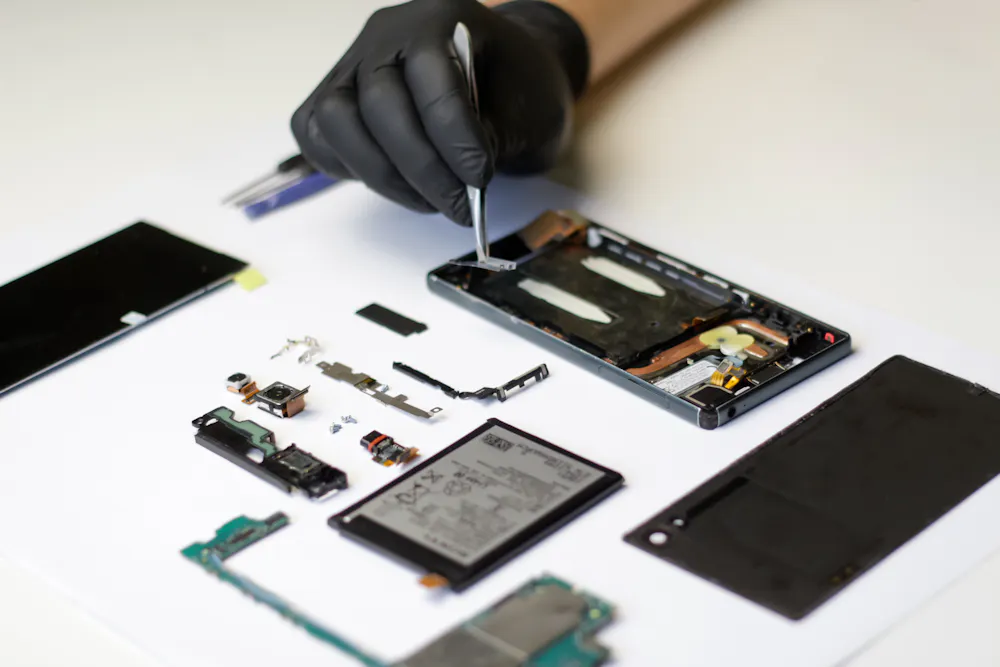
Biologist Iñaki Ruiz-Trillo and his colleagues use a smartphone analogy that we discover notably helpful when speaking concerning the origin of animals.
A smartphone was not invented from scratch. Cameras, telephones, computer systems and the web had been all invented individually first. The innovation was combining them right into a single piece of apparatus.
Tetiana Strilchuk/iStock via Getty Images Plus
Animals could have developed in the same manner. Genes for sticking cells collectively, for sending alerts between cells, for sensing the setting and for switching different genes on and off had been already current in our single-celled family. Changing into an animal meant assembling that instrument package into one cooperating physique.
The primary animal was most likely one thing very small, soft and unremarkable in an ancient ocean. It most likely developed over 650 million years in the past. It definitely had totally different sorts of cells that had been caught collectively, doing specialised jobs.
Scientists could by no means be capable of pinpoint the primary animal, and we have now a tough time making an attempt to think about it. However we do know that most of the mobile and molecular instruments that helped early animal cells work collectively are nonetheless at work in your physique at present.
Hi there, curious children! Do you’ve got a query you’d like an professional to reply? Ask an grownup to ship your query to CuriousKidsUS@theconversation.com. Please inform us your identify, age and the town the place you reside.
And since curiosity has no age restrict – adults, tell us what you’re questioning, too. We received’t be capable of reply each query, however we are going to do our greatest.