The Finest Transportable SSDs for Photographers in 2026
One of the best moveable SSD for many photographers proper now could be the SanDisk Extreme Portable SSD V3. In case you shoot on a Mac, the Samsung T7 Shield is the higher purchase, for causes that catch lots of people out. I’ve a pc science diploma, I’ve been constructing my very own computer systems since I used to be 18, and I’ve had sufficient exterior drives die on me throughout journeys to have opinions about connectors.
The drive itself is the straightforward half of the choice, although. What truly retains your pictures protected is the system round it – what goes on the drive every night, the place the second copy lives, and what occurs if you get dwelling. At dwelling, my model of that system ends at a NAS in a cabinet with over 10TB mirrored to the cloud. On the highway, it begins with a drive sufficiently small to dwell in a jacket pocket.
A fast word on how I’ve picked these. The specs beneath are checked towards every producer’s personal documentation, and for lab benchmarks I’ll level you at PetaPixel and Imaging Resource, who run sustained switch checks I’m not outfitted to do higher. What I can add is the half the spec sheets don’t let you know – which of these numbers are actual on the pc you truly personal, and the best way to set issues up so a useless drive is an annoyance fairly than a catastrophe.
The Finest Transportable SSDs for Photographers at a Look
Listed here are my 9 picks. Each hyperlinks all the way down to a full write-up additional on on this information, and each drive was in inventory on the time of writing.
Transportable SSD Comparability Desk
The desk beneath compares the important thing specs aspect by aspect. The place a rated pace wants a selected port to be achievable, I’ve stated so, as a result of that’s probably the most deceptive quantity on any SSD field. Extra on that within the speed and interfaces section.
| Drive | Finest For | Interface | Rated Velocity (Learn) | Capacities | Safety | Guarantee |
|---|---|---|---|---|---|---|
| SanDisk Extreme Portable SSD V3 | Finest general | USB-C, 20Gbps class | As much as 2,000MB/s (wants a 20Gbps port) | 1TB to 4TB | IP65 | 5 years |
| Lexar ES3 | Finest funds SSD | USB-C, 10Gbps | As much as 1,050MB/s | 1TB, 2TB | Drop rated to 2m | See producer |
| Lexar SL500 | Finest worth high-speed | USB-C, 20Gbps | As much as 2,000MB/s (wants a 20Gbps port) | 1TB to 4TB | IP54, drop rated to 2m | 5 years |
| Samsung T9 | Quickest over USB | USB-C, 20Gbps | As much as 2,000MB/s (wants a 20Gbps port) | 1TB to 4TB | Drop rated to 3m | 5 years |
| Samsung T7 Shield | Finest for Mac customers | USB-C, 10Gbps | As much as 1,050MB/s | 1TB to 4TB | IP65, drop rated to 3m | 3 years |
| SanDisk Professional PRO-G40 | Finest for professional workflows | Thunderbolt 3 (40Gbps) + USB-C (10Gbps) | As much as 3,000MB/s (Thunderbolt 3 solely) | 1TB to 4TB | IP68, drop rated to 3m, crush resistant | 5 years |
| LaCie Rugged SSD4 | Hardest drive | USB 40Gbps | As much as 4,000MB/s (wants a 40Gbps port) | 1TB to 4TB | IP54, drop rated to 3m, crush resistant | 3 years + knowledge restoration service |
| OWC Envoy Ultra | Thunderbolt 5 ceiling | Thunderbolt 5 (80Gbps) | Over 6,000MB/s burst (~1,350MB/s sustained write) | 2TB to 8TB | IP67 | 5 years |
| Seagate One Touch HDD | Chilly archive at dwelling | USB 5Gbps (Micro-B) | No printed determine (mechanical drive) | 1TB to 5TB | None claimed | 2 years (US) |
The Drive Is Not the Backup
A drive by itself is only a second place for issues to go improper. What protects your pictures is the routine you construct round it.
The framework is named 3-2-1, and in plain English it means three copies of your pictures, on not less than two various kinds of storage, with one copy someplace bodily totally different from the others. It appears like overkill till the day it isn’t. I’ve had drives fail on journeys greater than as soon as, and the one cause these tales are boring is that there was all the time one other copy.
Right here’s what that appears like in observe whilst you’re travelling. Your pictures begin on the reminiscence card. Every night, you copy them to your moveable SSD. Then, and that is the necessary bit, you don’t delete them from the cardboard. A card you haven’t wiped is a free second copy, which can be a very good argument for carrying extra capability in playing cards than you suppose you want. I’ve lined card selection intimately in my information to the most effective reminiscence playing cards for pictures. That leaves you at two copies fairly than three, which on a brief journey I’ll dwell with till I’m dwelling.
For longer journeys, or any journey the place the pictures actually matter, the third copy comes with me. I carry two drives and hold them in numerous baggage. One travels in my digital camera bag, the opposite stays within the baggage or with Jess. A thief takes a bag, not a system.
If you get dwelling, the journey copies come off the drives and into wherever your photograph library completely lives. In my case that’s a NAS buzzing away in a cabinet, holding over 10TB of pictures, all of it mirrored to Backblaze cloud backup. The cloud copy is for the day the cabinet itself is the issue.
Backblaze is $9 a month per pc for limitless knowledge, and that hyperlink is a referral hyperlink that will get you a full free month to attempt it fairly than the usual 15 day trial (I get a free month too in case you enroll, so we each win!).
You don’t want my precise setup, in fact. A desktop pc, one massive archive drive and a cloud subscription does the identical job. The precept is the factor, and I’ve written a full information to photograph backup that covers it finish to finish, plus a chunk on maintaining your knowledge protected on the highway.
How A lot Storage Do You Want for Picture Backup?
“Get 2TB” is the usual recommendation, and it’s not improper, however you are able to do higher with thirty seconds of arithmetic.
A RAW file from a contemporary 45 megapixel digital camera runs round 45MB. On a heavy journey day I would shoot 400 frames. That’s about 18GB a day, so a two week journey of enthusiastic capturing comes out at roughly 250GB. That’s what a single drive wants to carry whereas your reminiscence playing cards carry the second copy. In case you’d fairly have each copies on drives, funds that 250GB twice: 500GB on one drive, or 250GB on every of two.
That makes 1TB the wise flooring for many photographers, and it’s why nearly each drive on this information begins there. Go to 2TB if any of those apply: you shoot video (even modest 4K eats storage at a charge stills by no means method), your journeys run longer than a few weeks, otherwise you’d fairly not give it some thought once more for a couple of years.
Purchase the following measurement up from regardless of the arithmetic says. Future you shoots greater than current you thinks, and the per terabyte worth drops as capacities rise anyway.
All of this prices greater than it did. Storage costs roughly doubled by means of 2026 as AI knowledge centres purchased up many of the world’s reminiscence manufacturing, and NAND provide isn’t anticipated to loosen earlier than late 2027. The arithmetic above hasn’t modified, however sizing up is a dearer behavior than it was once, so if the funds is tight, measurement to the arithmetic and no additional. And if a drive you need goes at a good worth, take it fairly than holding out for a greater one. I wouldn’t wager on a greater one arriving this 12 months.
One entice value flagging. The OWC Envoy Extremely on this record begins at 2TB, and the SanDisk V3 line lists a 500GB mannequin that, as of August 2026, isn’t truly transport but, so 1TB is its actual flooring. Capability ranges on packing containers and web sites are aspirational extra usually than you’d count on.
SSD or Laborious Drive for Picture Backup?
For journey, this one’s straightforward. An SSD has no shifting components, so a drop that might kill a spinning onerous drive is often a non-event. It’s additionally a number of occasions quicker and half the load. Each drive of mine that died on the highway was a mechanical drive, and moveable SSDs have eliminated most of these failure modes. For the drive in your bag, purchase an SSD and don’t look again.
The archive shelf at house is a extra attention-grabbing query, and it’s the place the web’s favorite declare wants correcting. You might have learn that SSDs “overlook” their knowledge after a 12 months unplugged.
The true image is a bit subtler. An SSD shops your pictures as electrical cost trapped in reminiscence cells, and that cost does leak over time, quicker when the drive is heat and quicker nonetheless because the drive wears out.
However the usually quoted one 12 months determine is a certification minimal for a drive on the very finish of its rated life, not a prediction for the calmly used drive in your drawer. No person publishes an sincere quantity for that drive, as a result of it depends upon too many issues.
What the producers do publish is telling in its personal means. Dell and IBM each advise datacenter clients to energy up saved SSDs each couple of months. That’s conservative, enterprise grade warning, however the underlying physics applies to your drive too: an SSD is just not a set-and-forget archive medium.
A tough drive shops knowledge as magnetic domains on a platter, which don’t have that individual decay mode, and at archive sizes it prices a fraction of the value per terabyte. That’s the case for the Seagate One Contact on the finish of this record. However onerous drives have their very own methods of dying on a shelf – bearings and motors that object to spinning up after an extended sleep – so that you’re swapping one set of failure modes for one more, not escaping them.
Which brings us again to the actual reply. No single drive of any sort is an archive. A couple of copy is the archive, and ideally a kind of copies is within the cloud.
Velocity, Interfaces, and What Your Laptop computer Will Really Give You
That is the part I most want somebody had written years in the past, as a result of the pace on the field is a negotiation, not a promise. A drive and a pc speak over a bus, and the switch runs on the pace of whichever aspect is slower.
The USB naming scheme does its finest to cover this. The spec identify for a 20Gbps port is “USB 3.2 Gen 2×2”, which is, unhelpfully, twice as quick as “USB 3.2 Gen 2”. The USB requirements physique has largely given up on these names and now simply manufacturers ports by pace – USB 10Gbps, USB 20Gbps, USB 40Gbps – in order that’s what I’ll use right here. As a rule of thumb, a 10Gbps port tops out round 1,000MB/s of actual switch, a 20Gbps port round 2,000MB/s, and a 40Gbps Thunderbolt or USB4 port round 3,000MB/s or extra.
Now the entice. Three drives on this information – the SanDisk V3, the Samsung T9 and the Lexar SL500 – promote speeds round 2,000MB/s, which requires a 20Gbps port. Virtually no pc has one. A handful of desktop motherboards and a small variety of Home windows laptops do, and that’s about it. Apple’s own port documentation lists no 20Gbps USB mode on any present Mac; the quickest non-Thunderbolt USB mode Apple paperwork is 10Gbps. Plug a T9 right into a MacBook Professional and it negotiates all the way down to 10Gbps, and also you get roughly half the marketed pace.
That inverts the standard shopping for logic. On a Mac, the Samsung T7 Protect, an older and cheaper 10Gbps drive, provides you each megabyte per second you paid for. The newer, dearer T9 provides you about half of what you paid for, and each find yourself on the similar actual pace. That’s why my Mac choose is the T7 Protect, and it’s a caveat you’ll not often discover printed subsequent to the T9’s headline quantity.
Two extra port details earlier than the picks. “USB4” on a spec sheet doesn’t assure 40Gbps, for the reason that USB4 specification permits slower implementations, so belief the Gbps determine, not the identify. And on Thunderbolt: variations 3 and 4 each run at 40Gbps, whereas Thunderbolt 5 runs at 80Gbps for storage (you’ll see 120Gbps quoted, however that’s a show mode, not a file switch pace).
Lastly, all of those drives are bus powered, which largely works brilliantly. There are two exceptions to plan for. Lengthy transfers generate warmth and quick drives will decelerate after they get scorching, and in case you offload direct from a USB-C iPad or telephone, the drive is ingesting out of your machine’s battery whereas it does it. In case you’re selecting a pc to pair with a quick drive, port choice is another reason to learn my information to the most effective laptops for photograph enhancing.
The Finest Transportable SSDs and Exterior Drives for Photographers in 2026
On to the drives. For each you’ll discover the important thing specs, who it fits, and something the advertising doesn’t point out. Costs proven are dwell from Amazon.
SanDisk Excessive Transportable SSD V3 – Finest Total

That is the drive I’d hand most photographers. It’s quick, it’s small, it has an IP65 score towards mud and splashed water, and the guarantee runs 5 years, which is nearly as good as this class will get.
The V3 is the third era of SanDisk’s Excessive line, launched in February 2026. If that line rings a bell, it’s in all probability due to the 2023 failures that hit some earlier Excessive and Excessive PRO fashions. I cowl precisely what occurred within the drive failure section beneath, and it’s value studying before you purchase something. The V3 is a distinct product era with no advisory towards it, but it surely’s additionally solely been on sale a couple of months, so its long run document doesn’t exist but. Mine wouldn’t be the one copy of something, and yours shouldn’t be both.
One spec word. The marketed 2,000MB/s is a 20Gbps port determine. On the 10Gbps ports most laptops have, together with each present Mac, you’ll see round half that, which continues to be lots quick for photograph offloads.
- Capacities: 1TB, 2TB, 4TB (a 500GB mannequin is listed however not but transport as of August 2026)
- Rated pace: as much as 2,000MB/s (20Gbps port required)
- Interface: USB-C
- Safety: IP65 rated, drop examined
- Guarantee: 5 12 months restricted
- Check price on Amazon
Check the SanDisk Extreme V3 price on Amazon here.
Lexar ES3 – Finest Funds SSD

The most affordable drive on this information, and a very good instance of how far the funds finish of moveable SSDs has come. The ES3 is a 10Gbps drive rated to 1,050MB/s, which as we lined above is similar actual world pace most laptops will get from drives costing significantly extra. It’s tiny, fairly gentle at round 42g, and drop rated to 2m.
The compromises are those you’d count on on the worth. There’s no IP score, and Lexar doesn’t publish a guaranty time period for it anyplace I may discover, which is a bit odd (their different SSD strains run three to 5 years). Verify what your retailer states earlier than shopping for. It additionally ships with a useful 2-in-1 cable that covers each USB-C and USB-A computer systems.
For a primary backup drive, or the second drive in a two drive journey setup, it’s a very easy advice.
- Capacities: 1TB, 2TB
- Rated pace: as much as 1,050MB/s
- Interface: USB-C (2-in-1 USB-C/USB-A cable included)
- Safety: drop rated to 2m, no IP score
- Guarantee: not printed, verify with retailer
- Check price on Amazon
Check the Lexar ES3 price on Amazon here.
Lexar SL500 – Finest Worth Excessive-Velocity Drive

The SL500 is the worth play within the 2,000MB/s class, often undercutting the Samsung T9 whereas matching its headline numbers. It’s remarkably skinny at 7.8mm, weighs 43g, carries an IP54 score and a 2m drop score, and the guarantee runs 5 years.
The identical 20Gbps caveat applies right here as to the T9: you want a 20Gbps port to see 2,000MB/s, and most computer systems, together with each present Mac, will run it at round 1,000MB/s as an alternative. If that describes your machine, purchase the ES3 or T7 Protect and save the distinction. However in case you have a 20Gbps port, or desire a drive that can outlive your present laptop computer’s ports, that is the wise means to purchase that pace.
It’s additionally explicitly marketed for telephones and tablets, and its slim form makes it the least awkward drive right here to dangle off an iPad on location.
- Capacities: 1TB, 2TB, 4TB
- Rated pace: as much as 2,000MB/s learn, 1,800MB/s write (20Gbps port required)
- Interface: USB-C
- Safety: IP54 rated, drop rated to 2m
- Guarantee: 5 12 months restricted
- Check price on Amazon
Check the Lexar SL500 price on Amazon here.
Samsung T9 – Quickest Over USB
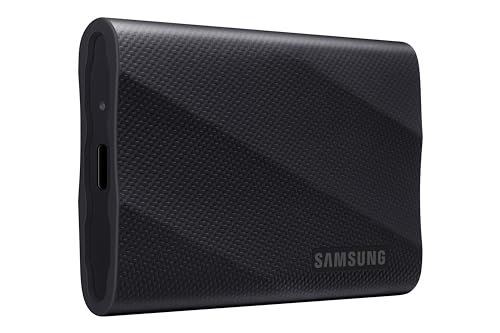
The T9 is the quickest pure USB drive on this information, with as much as 2,000MB/s learn and almost the identical write, a physique drop rated to 3m, and Samsung’s 5 12 months guarantee.
the caveat by now, and with this drive it issues most since you’re paying a premium particularly for the pace. On a 20Gbps port it’s very good, and sustained write efficiency holds up nicely on massive video offloads. On the 10Gbps port of a MacBook, it runs at half its rated pace and also you’ve paid T9 cash for T7 Protect efficiency.
So the shopping for rule is straightforward. When you’ve got a Home windows machine with a 20Gbps port, otherwise you’re shifting a whole lot of gigabytes at a time, the T9 is the drive. On a Mac? Maintain studying.
- Capacities: 1TB, 2TB, 4TB
- Rated pace: as much as 2,000MB/s learn (20Gbps port required)
- Interface: USB-C
- Safety: drop rated to 3m
- Guarantee: 5 12 months restricted
- Check price on Amazon
Check the Samsung T9 price on Amazon here.
Samsung T7 Protect – Finest for Mac Customers
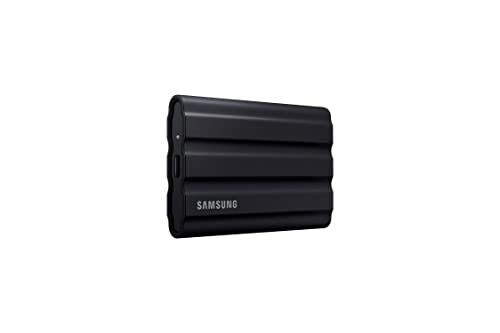
Right here’s the choose that appears improper on paper and proper in observe. The T7 Shield is a 10Gbps drive rated to 1,050MB/s, and 10Gbps is the ceiling for an bizarre USB drive on any present Mac. In need of going to Thunderbolt, each megabyte per second you pay for past that’s wasted. The Protect delivers its whole rated efficiency, prices lower than the T9, and provides issues the T9 doesn’t have, together with an IP65 score and a chunky rubber jacket that shrugs off rain and a 3m drop.
That score means splashes and rain, by the way in which, not swimming. No drive on this information wanting the PRO-G40 and Envoy Extremely ought to ever go underwater.
The trade-offs are a 3 12 months guarantee towards the T9’s 5, and the plain one: in case you later transfer to a machine with 20Gbps or Thunderbolt ports, the Protect stays a 1,050MB/s drive. For MacBook photographers, that’s a commerce I’d make with out hesitating.
- Capacities: 1TB, 2TB, 4TB
- Rated pace: as much as 1,050MB/s (achievable on any present Mac)
- Interface: USB-C
- Safety: IP65 rated, drop rated to 3m
- Guarantee: 3 12 months restricted
- Check price on Amazon
Check the Samsung T7 Shield price on Amazon here.
SanDisk Skilled PRO-G40 – Finest Thunderbolt Drive for Professional Workflows
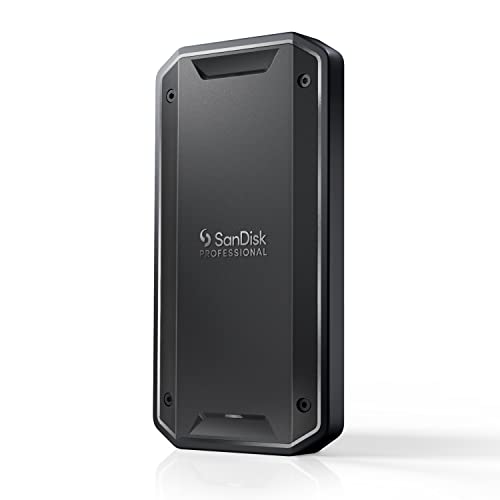
The PRO-G40 is the drive for photographers whose deadlines are shorter than their card offloads. Over Thunderbolt 3 it strikes knowledge at as much as 3,000MB/s learn and a couple of,500MB/s write, and in contrast to quite a lot of two mode drives it degrades gracefully: plug it right into a plain USB-C port and it nonetheless runs as a traditional 1,050MB/s drive.
It’s additionally constructed prefer it expects to be trodden on. The IP68 score is an actual immersion score, not like the splash rankings elsewhere on this record, it’s drop rated to 3m, and it’s rated towards 4,000lb of crush drive, which is roughly the load of a automotive.
Two issues to verify earlier than shopping for. Full pace requires an precise Thunderbolt port (any Thunderbolt-equipped Mac qualifies, as do many greater finish Home windows laptops), and it’s priced just like the skilled device it’s. For a working photographer shifting massive shoots day by day, it repays that shortly.
- Capacities: 1TB, 2TB, 4TB
- Rated pace: as much as 3,000MB/s learn, 2,500MB/s write through Thunderbolt 3; 1,050MB/s through USB-C
- Interface: Thunderbolt 3 (40Gbps) + USB-C (10Gbps)
- Safety: IP68 rated (immersion rated), drop rated to 3m, 4,000lb crush resistance
- Guarantee: 5 12 months restricted
- Check price on Amazon
Check the SanDisk PRO-G40 price on Amazon here.
LaCie Rugged SSD4 – Hardest Drive

LaCie’s orange Rugged drives have been a fixture on movie and photograph shoots for 20 years, and the SSD4 is the present era. It’s a USB 40Gbps drive rated to a considerable 4,000MB/s learn, drop rated to 3m, rated towards a full ton of crush drive, and IP54 rated towards mud and splashes – with the caveat that the score depends upon the port cap truly being seated, which it received’t be whereas the drive is plugged in and dealing.
The spec that makes it attention-grabbing for this text, although, is the guarantee. Three years is the shortest SSD guarantee right here, but it surely consists of Seagate’s Rescue knowledge restoration service: if the drive dies inside that interval, they’ll try and recuperate your information as soon as, free. Skilled knowledge restoration usually prices critical cash, and no different drive on this information consists of it.
Seagate does word that Rescue isn’t accessible in each nation, so verify yours if that’s why you’re shopping for. For a sure type of traveller, it beats two additional years of {hardware} guarantee comfortably.
The 4,000MB/s wants a 40Gbps port (USB4 or Thunderbolt); on bizarre 10Gbps ports it’s a quick on a regular basis drive like every little thing else right here.
- Capacities: 1TB, 2TB, 4TB
- Rated pace: as much as 4,000MB/s learn (40Gbps port required)
- Interface: USB 40Gbps (USB-C)
- Safety: IP54 rated (cap seated), drop rated to 3m, 1 ton crush resistance
- Guarantee: 3 12 months restricted, together with Rescue knowledge restoration
- Check price on Amazon
Check the LaCie Rugged SSD4 price on Amazon here.
OWC Envoy Extremely – The Thunderbolt 5 Ceiling

That is what the highest of the market seems like in 2026. The Envoy Ultra is a Thunderbolt 5 drive that bursts previous 6,000MB/s, it’s IP67 rated, and it begins at 2TB. It’s the quickest factor right here by a distance, and the one drive on this information that prices greater than some cameras.
Two numbers behind the headline deserve daylight. OWC’s personal spec sheet places sustained write on the 2TB mannequin at round 1,350MB/s, and sustained is the quantity that issues if you’re dumping a complete shoot, not copying one file. Nonetheless fast, however a good distance from six thousand. And Thunderbolt 5 hosts are uncommon: as of mid 2026 that largely means latest M4 Professional and Max class Macs and a small set of PCs, although it falls again fortunately to Thunderbolt 4 and USB4 at these buses’ speeds.
One design quirk to weigh: the cable is constructed into the drive. Nothing to overlook on the resort, but additionally nothing to switch if the cable itself will get broken, which is a little bit of an odd gamble for a drive this ruggedly constructed. Purchase it in case you have the host to feed it and a video-heavy workflow; in any other case the PRO-G40 does the professional job for a lot much less.
- Capacities: 2TB, 4TB, 8TB (no 1TB choice)
- Rated pace: over 6,000MB/s burst; round 1,350MB/s sustained write (2TB mannequin)
- Interface: Thunderbolt 5 (80Gbps), built-in cable
- Safety: IP67 rated (immersion rated)
- Guarantee: 5 12 months restricted
- Check price on Amazon
Check the OWC Envoy Ultra price on Amazon here.
Seagate One Contact HDD – Finest Laborious Drive for a Chilly Archive

The one deliberate onerous drive within the record, right here for a distinct job. The One Touch is just not the drive to your digital camera bag – it’s mechanical, so a tough drop can kill it, and it carries no safety rankings in any respect. It’s the drive for the shelf: a budget, capacious second or third copy that lives at dwelling whereas your SSDs journey, and the reply to the cost leakage query from the SSD versus hard drive section.
Per terabyte it prices a fraction of any SSD right here, capacities run to 5TB, and this specific variant provides {hardware} encryption with password safety, which is a wise characteristic on a drive that can maintain your whole library. It connects over USB 3.0 with the older Micro-B socket, and Seagate publishes no switch pace determine, as a result of a mechanical drive would embarrass itself subsequent to the numbers above. For a shelf archive, that doesn’t actually matter.
One quantity to notice: the US guarantee is 2 years, the shortest on this information, and shorter than the three years some worldwide datasheets quote for a similar drive.
- Capacities: 1TB, 2TB, 4TB, 5TB
- Rated pace: no printed determine (mechanical drive, USB 5Gbps bus)
- Interface: USB 3.0 (Micro-B connector)
- Safety: none claimed; {hardware} encryption with password safety
- Guarantee: 2 12 months restricted (US)
- Check price on Amazon
Check the Seagate One Touch price on Amazon here.
Formatting Your Drive for Mac and PC
A model new drive often arrives formatted as exFAT, and for many photographers the suitable transfer is to go away it that means. exFAT is the one format that Home windows, macOS, iPads and most cameras can all learn and write, which issues the second your backup workflow touches a couple of machine.
In case your drive will solely ever meet Macs, APFS is a greater citizen there, and it’s required if you wish to use the drive for Time Machine. Reformatting takes a minute in Disk Utility (choose the drive, Erase, select the format). Home windows-only households can use NTFS through the Format choice in File Explorer, although I’d nonetheless default to exFAT except you’ve got a selected cause, since a Mac can solely learn NTFS, not write to it.
The catch with exFAT is that it has no journaling, which implies it’s a bit much less forgiving if a drive is yanked mid-write. Eject the drive earlier than you unplug it. Sure, everybody skips this. Do it anyway on the drive that holds the one area copy of your journey.
What Drive Failure Really Seems to be Like
Each article like this says “drives fail, again up your pictures”. I’d fairly present you what that sentence truly means, as a result of I’ve lived it a number of occasions.
None of my drives went out with a bang. They fade. In my expertise the weak level was almost all the time the USB connector fairly than the storage itself: a port that received wobbly, then a drive that mounted on the third try, then one morning nothing in any respect. That period’s drives had been mechanical with fragile sockets. At present’s USB-C connectors are noticeably sturdier and SSDs take away the shifting components, however sockets nonetheless put on, cables nonetheless fray, and controllers nonetheless die.
The size of it’s measurable. Backblaze, the cloud backup firm, publishes failure statistics on its datacenter fleet, and throughout 344,196 onerous drives its 2025 annual failure charge was 1.36%, roughly one drive in 74 per 12 months in local weather managed racks doing nothing however their job. These figures cowl onerous drives, not moveable SSDs, so deal with them as proof that storage fails routinely at scale fairly than as a prediction for the SSD in your bag. Your bag is a tougher life than a rack.
SSDs earn their very own cautionary story right here, and it’s latest. In 2023, some SanDisk Excessive and Excessive PRO moveable SSDs started failing within the area. SanDisk’s advisory described a firmware challenge that would trigger drives to “unexpectedly disconnect”, named the Excessive Transportable 4TB and the Excessive PRO Transportable in 1TB, 2TB and 4TB, and shipped a firmware replace.
Many affected customers reported one thing worse than disconnection: drives that by no means got here again. Engineers at a knowledge restoration agency, reported through Tom’s {Hardware}, attributed the failures to bodily design points fairly than firmware alone, and a consolidated class motion filed in 2023 stays unresolved, with no settlement as of this writing.
The present V3 era, my high choose above, is a distinct product household with no advisory towards it, however the episode is the clearest latest illustration of why a drive together with your solely copy on it’s a gamble, whoever made it.
So, sensible guidelines. When a drive begins behaving oddly, cease writing to it instantly and replica every little thing off whereas it nonetheless mounts, beginning with no matter exists nowhere else. If a drive with distinctive pictures on it dies outright, don’t reformat it, don’t run restore utilities over it, and don’t hold energy biking it; every try could make skilled restoration tougher, and restoration is an actual (if costly) business that usually pulls pictures off useless drives. That is additionally the place the LaCie SSD4’s bundled restoration service stops being a spec desk footnote and begins being the rationale somebody chooses it.
Or, higher than all the above: have the second copy, and let a useless drive be a procuring errand as an alternative of a disaster.
Regularly Requested Questions
Some fast solutions to the questions photographers most frequently ask about moveable SSDs and photograph backup drives.
What’s the finest moveable SSD for photographers?
For many photographers, the SanDisk Excessive Transportable SSD V3. It’s quick, small, IP65 rated towards mud and splashes, and carries a 5 12 months guarantee.
In case you use a Mac, purchase the Samsung T7 Protect as an alternative. Present Macs can’t use the quicker drives’ full pace, and the Protect delivers its whole rated efficiency for much less cash.
What’s the finest exterior onerous drive for photographers?
For journey, I’d steer you to a transportable SSD over a tough drive, since SSDs survive drops and knocks much better. The place a tough drive nonetheless wins is the archive copy at dwelling: the Seagate One Contact prices a fraction per terabyte and runs to 5TB, which is why it’s the archive choose on this information.
Ought to I again up pictures to an SSD or a tough drive?
Each, for various jobs. The SSD travels with you and holds the working copy. The onerous drive stays dwelling and holds the massive, low cost archive copy.
The true reply is a couple of copy on a couple of machine, with one copy off-site or within the cloud. That’s the 3-2-1 method lined earlier on this information.
What measurement moveable SSD do I would like for photograph backup?
1TB covers most stills photographers. A 45MB RAW file, 400 frames a day and a two week journey involves roughly 250GB on the drive, together with your reminiscence playing cards holding the second copy. In case you’d fairly each copies had been on drives, that’s 500GB, so 1TB nonetheless leaves snug headroom.
Go to 2TB in case you shoot video, journey for longer stretches, or just don’t wish to do that arithmetic once more for a couple of years.
Are moveable SSDs dependable sufficient for pictures?
Trendy moveable SSDs from the main manufacturers are dependable, and with no shifting components they deal with journey much better than onerous drives. However no drive is dependable sufficient to carry the one copy of your pictures, because the 2023 SanDisk failures demonstrated even from a significant model.
Deal with each drive as one thing that can finally fail, and hold a second copy. Reliability is a property of your system, not of any single drive.
Do SSDs lose knowledge if left unplugged?
Ultimately, sure. An SSD shops knowledge as electrical cost, which slowly leaks, quicker in heat storage and quicker because the drive wears. The “SSDs overlook after a 12 months” declare overstates it although, as that determine is a certification minimal for a drive on the finish of its rated life, not typical behaviour.
No person can provide you a dependable quantity for a way lengthy a calmly used SSD holds knowledge on a shelf. So don’t use one as your solely long run archive; hold an archive copy on a tough drive or within the cloud, and energy the SSD up at times.
Ought to I format my drive as exFAT for pictures?
Sure, if the drive will contact a couple of sort of machine. exFAT is the format Home windows, macOS, iPads and most cameras can all learn and write, and most moveable SSDs ship with it.
Use APFS as an alternative for a Mac-only drive (required for Time Machine), or NTFS for a Home windows-only one. Regardless of the format, eject the drive earlier than unplugging it.
Can I again up pictures to an SSD with no laptop computer?
Sure. A USB-C iPad or telephone can copy information from a card reader to a transportable SSD utilizing the built-in information app, and a few cameras can offload to a drive straight.
Two cautions: the drive runs off your machine’s battery whereas it copies, and the drive must be exFAT formatted for every little thing to learn it fortunately.
Why is my moveable SSD slower than marketed?
Virtually all the time the port, not the drive. The two,000MB/s class of drives wants a 20Gbps USB port, which just about no pc has; on a typical 10Gbps port, together with each present Mac, they run at about half their rated pace.
Gradual cables and warmth are the opposite ordinary suspects. Use the cable that got here with the drive, and count on lengthy transfers to decelerate because the drive warms up.
Do I would like a Thunderbolt SSD for pictures?
Most photographers don’t. A 1,050MB/s USB drive offloads a full day of RAW capturing in a couple of minutes, and Thunderbolt drives value considerably extra.
They make sense if you transfer very massive volumes on a deadline, shoot numerous excessive bitrate video, or edit straight off the drive, and provided that your pc has a Thunderbolt port to feed one.
Is the Samsung T9 higher than the T7 Protect?
On paper, sure: double the rated pace and a 5 12 months guarantee towards 3. In observe it relies upon solely in your pc’s ports.
On a Mac, or any machine with no 20Gbps USB port, the T9 runs on the similar actual world pace because the cheaper T7 Protect, and the Protect provides an IP65 score the T9 lacks. That’s why the Protect is my Mac choose.
Are rugged moveable SSDs waterproof?
Principally no, and the advertising blurs this. IP54 (LaCie Rugged SSD4) means splash resistance and IP65 (SanDisk V3, T7 Protect) means resistance to water jets, each with caps seated. Neither covers being dropped in water.
Precise immersion safety begins at IPX7: on this information, that’s the SanDisk PRO-G40 (IP68) and OWC Envoy Extremely (IP67). And word an IP score says nothing about drop safety, which is a separate spec.
What number of backup copies of my pictures do I would like?
Three is the usual reply: the 3-2-1 rule means three copies, on two various kinds of storage, with one copy someplace else solely, such because the cloud.
Whereas travelling, a sensible model is pictures in your reminiscence playing cards (don’t wipe them), a replica in your SSD, and ideally a second drive stored in a distinct bag.
Is cloud backup sufficient for pictures by itself?
Not whilst you’re travelling. Importing a few hundred gigabytes of RAW information over resort wifi isn’t lifelike, so the native drive copy does the work on the highway.
At dwelling, cloud backup is the perfect off-site leg of the system. I take advantage of Backblaze, which is $9 a month per pc for limitless knowledge and runs quietly within the background.
How lengthy do exterior drives final?
There’s no mounted lifespan, and averages mislead: Backblaze’s datacenter statistics present about 1.36% of onerous drives failing per 12 months in best circumstances, and drives in baggage dwell a rougher life than drives in racks.
Plan for failure fairly than towards it. Any drive can die on any day, and the photographers who by no means lose pictures are those with a second copy, not those with fortunate drives.
Ought to I keep away from SanDisk SSDs after the 2023 failures?
I don’t suppose so, however purchase together with your eyes open. The 2023 advisory lined particular earlier Excessive and Excessive PRO fashions, and the present Excessive V3 is a distinct product era with no advisory towards it.
The truthful criticism is that the V3 can be younger, with no long run monitor document but. My view is that the episode adjustments how it’s best to use each drive, from any model, fairly than which model you purchase: hold a second copy, all the time.
Additional Studying
If this information was helpful, these are the items I’d learn subsequent. They’re all primarily based on our personal expertise.
And that’s it. Decide the drive that matches your ports and your funds, purchase a measurement up, and provides your pictures a second dwelling. The drive is the straightforward half.