
The identical yr that Christopher Nolan’s “The Odyssey” has damaged box office record after box office record, Canadian poet, essayist and translator Anne Carson has been awarded the Nobel Prize in literature on the age of 76.
Though Nolan and Carson differ in strategy, medium and significant reception, each have sought to make works of historic Greece new for a up to date viewers.
This inventive accessibility is probably going at the least a part of why the Nobel committee has seen match to honor Carson’s “bold and inventive” physique of labor, which defies style: Her poems, essays, translations, stage productions and collaborations typically evoke one other time and place however communicate freshly and vividly to audiences right this moment.
Translation made unique
Take, for instance, her 2019 staged efficiency, “Norma Jeane Baker of Troy.” In it, Carson overlays Helen of Troy with Marilyn Monroe in an effort to discover the damaging energy of magnificence. By revisiting an historic determine blamed for the Trojan war by way of the lens of a 20th-century sex symbol, Carson invitations audiences to mirror on the methods each girls have come to signify glamour and tragedy.
Her 2015 translation of the play “Antigone,” which toured internationally, hews nearer to Sophocles’ unique. But her lively version inflects this historic tragedy with a up to date voice. Creon’s lament over his useless spouse, which Richard C. Jebb interprets as “O depressing that I’m, and steeped in depressing anguish!” is rendered in her translation “now I’m completely blended with ache.” Jebb’s Antigone says “ah me sad! who haven’t any house on the earth or within the shades” whereas Carson’s says “I’m an odd new sort of inbetween factor aren’t I” about her dilemma.
Different tasks of hers veer into types the traditional world would have had bother recognizing. She collaborated with artist Rosanna Bruno on a 2021 graphic novel adaptation of Euripides’ play “The Trojan Girls,” first carried out in 415 B.C.E. In 2025, she even read her poems on an album for the indie rock band Rheostatics. Dave Bidini, one of many band’s founding members, described Carson as an artist who “hasn’t been afraid to experiment with language, to carve a spot that’s her personal along with her work.”
Leaving house for creativeness
The originality of her contribution also can come up from a refusal to do what many are likely to count on from translations of historic works particularly.
“If Not, Winter,” her 2002 translation of Sappho, drew consideration to the fragmentary nature of Sappho’s surviving work.
Only one complete poem of Sappho’s complete corpus exists: her “Ode to Aphrodite.” Of the remaining fragments, some are prolonged, some solely a phrase or two lengthy, typically quoted by different historic authors. A quantity had been present in shreds of papyri probably recycled to wrap mummies.
In her translation, the place papyri were tattered or a phrase obscured, Carson signifies this by using brackets and white space. Somewhat than eliding them, Carson finally ends up bringing consideration to those absences – an completely distinctive selection.
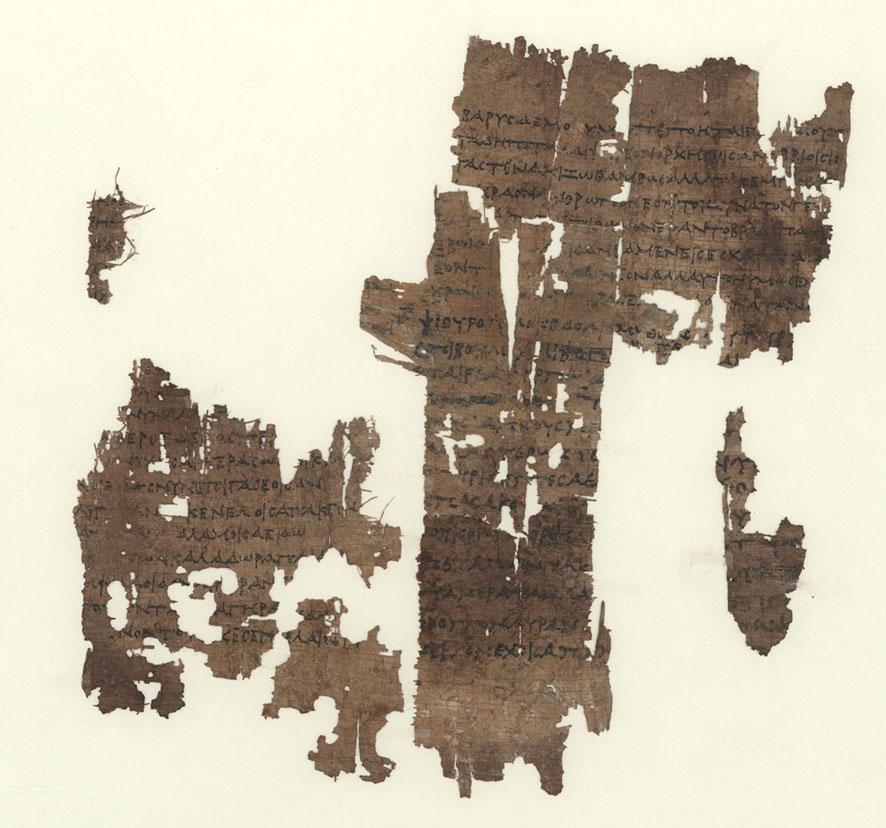


Oxford, Bodleian Library MS. Gr. class. c. 76 (P)/1-2
Carson states within the introduction to the interpretation that the brackets “suggest a free house of imaginal journey,” an invite to fill within the clean of language now misplaced to us. Moreover, as classicist and translator Emily Wilson notes, Carson “adds no possessive pronouns or definite articles” that aren’t current within the Greek, one other manner she lets modern readers meet Sappho’s fragments head on.
The place Carson lets an historic voice communicate with out interposition, some have discovered “her particular kind of austerity” wanting. Wilson, as an example, is important of Carson’s refusal to tilt her translation in a manner that acknowledges the necessary position that Sappho’s gender and sexuality have performed in her reception over time.
Wilson further critiques Carson’s “An Oresteia,” her 2010 translation and adaptation of performs by Aeschylus, Sophocles and Euripides.
Wilson writes that Carson “is acutely acutely aware of the variations, in temper, worldview and elegance, among the many three tragedians she interprets. It’s, then, a disappointment that she doesn’t fully achieve making them sound correctly distinct from each other.”
A working dialogue with literary greats
It might be that probably the most distinctive voice in Carson’s translations of historic authors is her personal. However even her unique work owes an evident debt to the phrases of others. She writes with and thru different literary voices all through her work.
Her lengthy poem “The Glass Essay” explores romantic heartbreak and familial sorrow in dialogue with the life and work of Emily Brontë.
“Nox,” an artwork e book and work of poetry created after her brother’s passing, can also be an exploration of the elegy that the Roman poet Catullus wrote to his own brother over 2,000 years earlier than.
And that is what Carson so typically does so effectively: She attracts the previous into the current and refreshes it for us with a poet’s capability for language and a classicist’s consciousness of the lengthy legacy of literature.