
There’s a robust scene in Moroccan-French-Israeli filmmaker Simone Bitton’s 2004 documentary “Wall,” which tells the story of the development of the West Bank barrier, a 448-mile – or 721-kilometer – community of partitions and fences dividing giant elements of the West Financial institution from Israel.
A concrete slab is slowly lowered into place with a view to full a bit of the wall. Inch by inch, the colourful, hilly Palestinian neighborhood on the opposite aspect will get smaller and smaller.
After which – identical to that – a world that’s a stone’s throw away is gone.
As someone who studies the restrictions positioned on Palestinians, I typically take into consideration this scene as a microcosm of Israel’s decades-long use of partitions, checkpoints and surveillance applied sciences to seal off Palestinians from the remainder of society.
Down The Rabbit Hole/YouTube
Nowhere is that this dynamic extra evident than the Gaza Strip, which Israel fenced in during the 1990s and has blockaded since 2007, citing safety issues and the specter of militant assaults.
Thanks to those limitations, the immense struggling of Palestinians in Gaza – more than 70,000 of whom have been killed because of the Israel-Hamas conflict since 2023 – has been tough to doc. The Israeli authorities largely bars worldwide journalists from getting into the Gaza Strip independently, whereas Palestinians in Gaza are typically not allowed to go away the Gaza Strip.
However the Sept. 10, 2026, premiere of Israeli filmmakers Yuval Abraham and Rachel Szor’s movie “NAZA” on the Venice Worldwide Movie Competition has put the highlight on the continuing tragedy in Gaza with out counting on footage of grotesque corpses or bombed-out neighborhoods.
The movie consists largely of nameless testimony from 24 members of Israel’s navy and intelligence companies. They talk about the methods by which Israel has used artificial intelligence to focus on Hamas officers, regardless of realizing the assaults will even generate giant numbers of civilian casualties. The title, “NAZA,” comes from an acronym for the Hebrew phrase “nezek agavi,” or “collateral harm,” and it’s the Israeli navy’s threshold system for what number of civilian casualties are acceptable in its navy strikes on Gaza since the Oct. 7, 2023, attacks. Hamas-led militants from Gaza launched these assaults in southern Israel, murdering 1,200 folks – principally civilians – and likewise taking about 250 hostages.
To me, a part of the movie’s energy lies in its deal with the medical means of finishing up strikes on Gaza from a distance. However the Israeli navy’s strategy might solely work after systematically isolating the Palestinian folks over the course of a long time.
Unseen victims
Along with setting up partitions and blockading Gaza, Israel has enforced separation of Palestinians by restricting or denying permits to Palestinians wishing to enter or work in Israel via aerial surveillance and through the expansion of Israeli settlements within the West Financial institution.
Each the visible language and the content material of “NAZA” replicate and reveal how data of Palestinian struggling is commonly mitigated in Israeli tradition, politics and every day life.
The movie juxtaposes audio of Israeli troopers’ testimony with pictures of the Tel Aviv cityscape at evening. In these interviews, the troopers map out how targets are chosen, how assaults are deliberate and the way a lot leeway is given for civilian casualties.
The victims themselves are largely unseen, regardless of their shut proximity: Tel Aviv sits a mere 43 miles – or 70 kilometers – up the coast from the Gaza Strip.
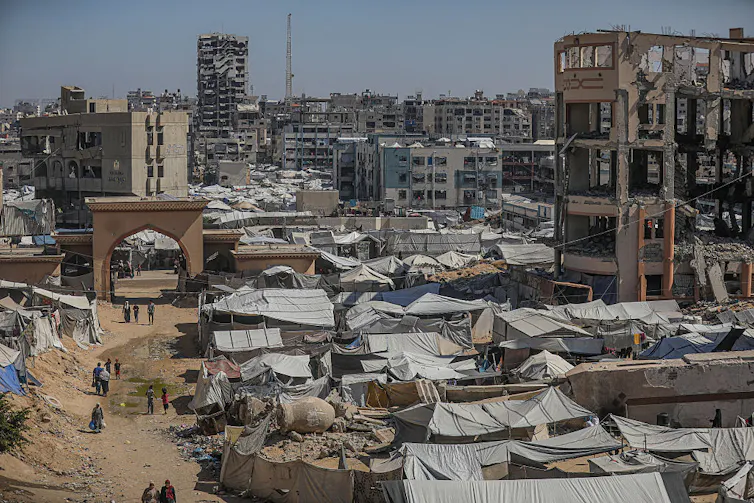
Faiz Qreqa/Middle East Images/AFP via Getty Images
The selection to movie primarily at evening, in darkness, utilizing disembodied voices to inform a narrative not depicted on digicam, additional highlights the extent to which these occasions have been obscured in Israel and all over the world. Maybe that’s why the Israeli authorities has gone to such nice lengths to discredit the movie, saying it comprises “deliberate distortions of reality.” Prime Minister Benjamin Netanyahu has threatened to revoke the citizenship of its directors.
In response to the curiosity and backlash surrounding the movie, the filmmakers announced that “NAZA” shall be accessible to stream at no cost, for anybody to see, starting in November 2026.
Breaking via
“NAZA” highlights a psychological distance between attacker and attacked that was enabled by AI, laptop screens and the bodily isolation of the targets. But it’s removed from the primary movie to name consideration to the invisibility of Palestinians.
Elia Suleiman’s 2002 darkish comedy “Divine Intervention” repeatedly phases scenes by which Palestinian characters are caught at or attempt to get round an Israeli navy checkpoint. And Yoav Shamir’s 2003 documentary “Checkpoint” chronicles on a regular basis interactions between Palestinians and Israeli troopers at checkpoints within the West Financial institution and Gaza.
Different movies heart on acts of transgression or protest. Hany Abu-Assad’s 2013 drama “Omar” and Ameen Nayfeh’s 2020 drama “200 Meters” each characteristic Palestinian characters who break the legislation and surreptitiously cross the West Financial institution border into Israeli territory, exposing themselves to bodily and authorized hazard.
“No Other Land” – the 2024 documentary that netted Abraham and Szor an Oscar, together with fellow administrators Basel Adra and Hamdan Ballal – factors the digicam on Palestinian protest actions in opposition to land expropriations and residential demolitions within the West Financial institution. Within the 2011 movie “5 Broken Cameras,” Palestinian farmer Emad Burnat captures his West Financial institution village’s wrestle in opposition to the development of a large wall that chokes off farmland and entry to important assets. At the same time as his cameras are repeatedly broken or destroyed, Burnat refuses to cease documenting the resistance.
Crying whereas capturing
“NAZA” additionally factors to a different phenomenon: how isolation and separation encourage complicity. The bodily distance between Israeli troopers and the folks they aim might make it simpler to go together with or ignore what is occurring.
On this means, “NAZA” grapples with a trope in Israeli movies and literature of exploring the guilt of Israeli troopers. Typically derisively referred to by critics as “shooting and crying,” the thematic framework of those movies has been criticized for specializing in Israeli ethical anguish on the expense of Palestinian experiences and views.
For instance, S. Yizhar’s 1949 novel, “Khirbet Khizeh,” which was tailored into a film in 1978, tells the story from the attitude of Micha, an Israeli soldier preventing within the 1948 conflict that established the state of Israel. He’s a part of a squad that expels Palestinians from their village, and his ensuing guilt provokes a disaster of conscience that haunts him for years to come back.
Many years later, the 2008 animated documentary “Waltz With Bashir” follows the movie’s director, Ari Folman, as he plumbs his repressed recollections of his participation within the 1982 Israeli invasion of Beirut and the way he inadvertently helped Lebanese Christian Phalangist militia fighters perform massacres of Palestinians at the Sabra and Shatila refugee camps.
The “capturing and crying” style was largely accepted in mainstream Israeli tradition, with “Khirbet Khizeh” taught in Israeli schools for many years. However the Israeli authorities’s hostile response to “NAZA” maybe indicators not solely the rising intolerance of dissent in Israel, but additionally a fading cultural and political concern with the morality of Israel’s occupation of Palestinian territory.
Whose voices get heard
The centering of Israeli views in these earlier works – in addition to in “NAZA” – additionally reveals how violence in opposition to Palestinians may be given better credence when it’s described by Israelis themselves.
Latest Palestinian narratives about Gaza, equivalent to “From Ground Zero” and “Thirteen in Gaza,” have garnered some attention and praise in the film world, however nowhere close to the identical quantity as “NAZA” has within the weeks since its premiere.
Even “No Different Land,” which is centered on a Palestinian village, options an Israeli journalist and filmmaker, Abraham, documenting the protests and confronting Israeli troopers, and should not have obtained the identical acclaim if it had been made totally by Palestinians.
But, regardless of these many limitations, Palestinians have by no means stopped discovering methods to make themselves heard. Along with movies like “Omar” and “200 Meters,” movies and pictures shared directly to social media have allowed Palestinians to attach straight with audiences and form international consciousness of their plight, particularly because the present conflict in Gaza started.
They’ve been capable of bypass the bodily limitations which have lengthy restricted their motion – and the cultural limitations which have typically stored their experiences out of sight.