
Easy methods to Hike the “Secret Again Method Path” Up Fushimi Inari
Chances are high, you have heard of Fushimi Inari Taisha, the Shinto shrine atop a mountain in Kyoto, Japan, that is recognized for its 10,000 vermillion torii gates that climb up the paths like dragon scales. This shrine is tremendous well-known, tremendous Instagram-famous — and due to this fact additionally tremendous crowded, particularly between the hours of roughly 8 a.m.-4 p.m. every day.
Now, you may after all get up very early to go to this shrine when it is a bit quieter. Or you may skip it altogether. However what for those who’re like me and do not wish to skip the enduring websites, however you additionally know you will not be waking up earlier than 6 a.m. if you do not have to?
Properly, I’ve some excellent news! You *can* keep away from among the crowds at Fushimi Inari and have a extremely distinctive go to for those who’re keen to (each actually and figuratively) get off the overwhelmed path. And I am right here to inform you precisely the right way to do it!


Learn on to study in regards to the “secret again means hike” at Fushimi Inari, which is able to take you to the highest of Mt. Inari by way of peaceable bamboo groves and moss-covered shrines.
What’s Fushimi Inari?
Fushimi Inari refers to a Shinto shrine on the foot of Mt. Inari in Kyoto that dates again to the 12 months 711 (with the present shrine having been inbuilt 1499). The shrine is devoted to Inari Okami, the Shinto kami (spirit/deity) related to each agriculture/farming (particularly rice) and enterprise/prosperity. Inari is commonly related to fox messengers (kitsune), which is why you may see depictions of foxes all around the shrine and mountain.

Together with the primary Fushimi Inari shrine, individuals go to this website to see the torii gates that climb up Mt. Inari. This path is kind of lengthy (Mt. Inari is 233 meters/764 toes tall), and alongside the way in which there are extra shrines and rock altars devoted to different deities.

Enjoyable truth: You have possible seen that the torii gates all have writing on them. You could assume that the messages are prayers or good needs associated to Inari — however you would be fallacious! Every gate is donated by an area enterprise or individual, and it is inscribed with the title of that enterprise, type of like an commercial! (Which, actually is sensible at a shrine devoted to prosperity.)
Many individuals go to Fushimi Inari Taisha lengthy sufficient to go to the primary shrine and to stroll up the primary part of torii gates referred to as Senbon Torii. They climb perhaps half-hour up the mountain, take a number of pictures, after which go away.
And that is fantastic, particularly for those who’ve acquired a busy Kyoto itinerary. BUT, if you wish to totally expertise and respect this sacred mountain, I encourage you to permit at the very least 2-4 hours to go to the very high.
RELATED: A Sensible 5 Days in Kyoto Itinerary
Mountaineering Fushimi Inari
There are a number of methods to achieve the shrines on the very high of Mt. Inari. If you happen to do the complete loop, the path is roughly 4 km (2.5 miles) lengthy. Which does not sound very lengthy, however keep in mind that you are climbing uphill for at the very least half the time, and there are certainly numerous steps and inclines, whatever the path you utilize!


The way in which most individuals climb to the highest is to simply comply with the primary path from the shrine entrance. This path shall be crowded near the underside of the mountain, however the crowds will skinny out the upper you go.
Many individuals solely hike as much as the Crossroads (the Mt. Inari Crossroads Observatory), which is an overlook over Kyoto the place the path splits after which circles the highest of Mt. Inari. Which means that for those who proceed on previous the Crossroads, it’s possible you’ll very properly be met with fully empty stretches of path, no matter what time of day it’s.

PRO TIP: If you happen to’re mountaineering up the primary path and wish to hike the mountaintop loop, take the path to the appropriate and do the loop counter-clockwise. The righthand path going up from the Crossroads has a much less steep incline/fewer steps, and shall be bathed in pretty daylight within the late morning/early-mid afternoon. You’ll be able to then hike again right down to the Crossroads by way of the opposite facet of the path, which shall be shady and steeper.
The opposite possibility for mountaineering to the highest is to take a “again means” up the mountain, which makes for an much more peaceable hike — and that is what I did!
Fushimi Inari “again means” hike
In the case of “secret again means” trails up Mt. Inari… properly, they actually aren’t all that secret. In reality, they’re all marked and signposted!
And whilst you *can* guide a guided hiking tour to take you up the mountain utilizing alternate trails, you positively do not should. Anybody can use these trails at any time free of charge, and I will inform you all in regards to the route I took.
Attending to Fushimi Inari
First off, it’s good to get your self to Fushimi Inari. The Shrine is just a little methods south of Kyoto metropolis middle, but it surely’s extraordinarily simple to achieve. Your choices are:
- Take the JR Nara Line from Kyoto Station to Inari Station. The journey takes 5 minutes, however make certain you are on an area prepare and never an categorical one that can skip Inari. From Inari station, you principally simply stroll throughout the road to the shrine entrance.
- Take the the Keihan Line (subway) to Fushimi Inari Station. This takes 10 minutes from central Kyoto, and from the station it is a couple of 5-10 minute stroll to the shrine entrance.
- Take a taxi. Once more, it is a brief journey, and you should use an app like GO to order a automotive proper to your lodge.
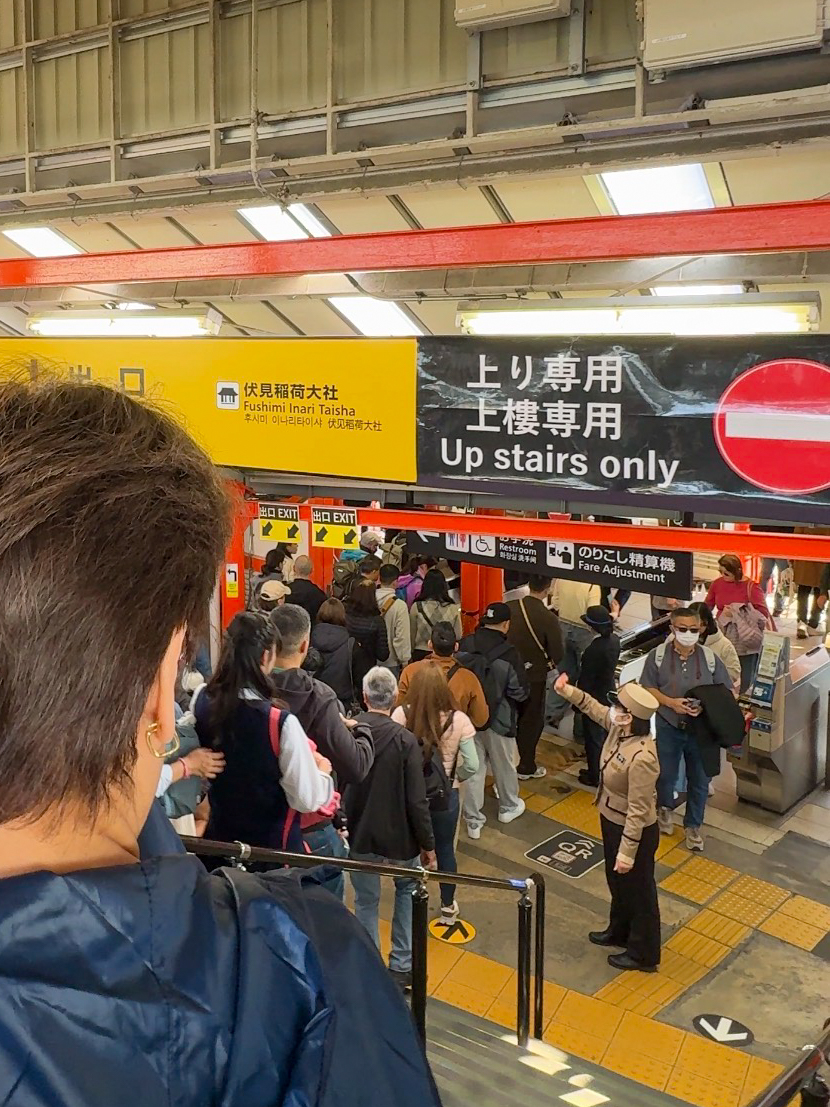
The place to start out your hike
Now, for those who’re doing a guided hike like this one or actually wish to keep away from individuals altogether in your means up the mountain, you possibly can technically skip the primary entrance to Fushimi Inari altogether. (I did not do it this manner, however it’s an possibility!)
You’ll be able to skip the primary path by solely taking the prepare to both Tofukuji Station (on each the JR and Keihan strains) or Tobakaido Station, after which making your means by means of a small neighborhood to Kyoto Path Station 4 Higashiyama (that is precisely the way it’s marked on Google Maps).
Kyoto Path Station 4 is the beginning of a path that really goes straight up the again of Mt. Inari. The path ultimately connects to the mountaintop loop at “Stone monument at Inariyama Sutra Mound,” and from there you possibly can loop across the mountain and hike down by means of all of the torii gates.
I am unable to personally vouch for this route, nevertheless, as it isn’t the way in which I did my hike! I really did wish to enter by means of the primary gate of Fushimi Inari, and I additionally wished to ensure I may simply comply with the path since I did this hike solo.

The Fushimi Inari secret again means mountaineering route
In my case, I entered Fushimi Inari by means of the primary gate and started strolling up the primary path together with everybody else. (There are bogs, memento stands, and locations the place you should buy want plaques and goshuin stamps right here close to the primary gate.)
I arrived at Fushimi Inari round 9:30 a.m. on a weekday, and as you possibly can see from the pictures under, it was extraordinarily crowded on the backside of the path. However keep on with me, as a result of it is price it!


I continued up the primary path by means of the Senbon Torii to the Okusha Worship Heart.
I did not know then what I do know now about this hike, and wasn’t positive the place precisely I wanted to depart the primary Fushimi Inari path.
After I arrived at Okusha Worship Heart (which has a small cafe, a store, and really clear public restrooms), I believed this was the place I used to be meant to depart the primary path. There is a spot on Google Maps close to right here marked as “Fushimi Inari Bamboo Forest,” and what seemed like a path past that, in order that’s the place I headed.
Now, this little bamboo grove IS pretty, however for those who comply with the path past it, one can find your self strolling previous tiny shrines and native houses — after which the path principally useless ends at somebody’s home. So no, this isn’t the path you need! (If you wish to detour to take some pictures within the bamboo grove, although, go for it!)

PRO TIP: Use the bogs on the Okusha Worship Heart! You will not discover any others in your means up the mountain.
As a substitute, from Okusha Worship Heart (or Omokaru Stone or Ōyabu Chaya, whichever you see in your Google Map), proceed following the primary torii gate path for about 100 toes extra in direction of Neagarimatsu. You will see a quick break within the torii gates and an indication on the appropriate facet of the path that claims 京都一周トレイル東山コース2-2・F35 (sure, it is in Japanese; this says Kyoto Circumference Path: Higashiyama Course 2-2 / F35 in English).
The path branches off and as much as the appropriate by way of some low steps, and it is the one you need! (It’s also possible to search for Fushimi Kandakara Shrine in your Google Map and head in direction of that, because it’s on the path you wish to take.)


As soon as you might be on this path, the individuals will magically disappear as you comply with it to the highest of the mountain. (I actually was skeptical of this as a result of the path actually is not *that* exhausting to seek out; however actually, on the busiest time of day on this mountain, the path was nearly empty.)
The primary part of this path is unpaved however simple to comply with by means of a number of bamboo groves. It is a mixture of flat and gently inclined as you begin regularly climbing the mountain.

You will cross a number of shrines and altars/native cemeteries, together with Fushimi Kandakara Shrine, Kobogataki Falls, and Aokigataki; you are welcome to go to any of those, however clearly be respectful of anybody worshipping.


You will ultimately come to a fork within the path, with an indication that can level you to the left. Proceed following the path previous the Narutaki wooden carving workshop, Shiragiku Waterfall, and Mikuri-no-taki Waterfall. (Be aware that the “waterfalls” listed below are principally simply little trickles of water that circulation or splash down into small shrines.)


There’s additionally a random merchandising machine out right here within the forest, which is able to dispense chilly drinks for a really affordable worth; for those who really feel such as you want a chilly drink, get it right here as a result of will probably be the most cost effective you may discover at this time!

You will ultimately attain one other fork within the path close to a constructing marked as 末広の滝 (Suehiro Falls) on Google Maps. There is no signage on the fork that I may see, and I made the error of taking the steps as much as the appropriate in direction of Ōiwa Ōkami Shrine. It is a pretty little detour, to be truthful, however do not proceed climbing the steps, as they ultimately useless finish!


As a substitute, the trail of stairs to the left at this fork is the right route (there’s a small signal when you get to the following nook pointing you in direction of Mt. Inari). That is the steepest a part of the hike, with a number of units of concrete steps to climb (I am undecided precisely what number of, however a pair hundred at the very least).


You will come by means of what appear like older torii gates on the high of all of the steps, after which for those who maintain following the path you may quickly see the primary path and its gates once more on the high of the mountain. You will be getting into the Mt. Inari loop path close to its southeastern finish, and should select which option to go.
You’ll be able to go both means right here, however I like to recommend turning left once you re-join the primary path.


You will briefly proceed climbing uphill, however quickly you may attain the shrine (Ichinomine/Kamisha shinseki) on the very high of the mountain. There is a store right here, however observe that it is principally meant for individuals to purchase choices for the shrine, and shouldn’t be used as a relaxation space.

When you have a good time reaching the highest of the hike, then it is time to begin mountaineering again down the mountain. I continued down the primary path (clockwise on the loop from the highest of the mountain), since from this course it is this facet of the path that has the nicest lighting. (It does imply I didn’t do the complete loop on the high of Mt. Inari, however that was okay with me as I used to be fairly comfortable not climbing up any extra steps!)
You will cross a number of extra shrines and present outlets in your means down, together with Ninomine (Nakasha Shinseki), Ainomine (Kadasha shinseki), and Sannomine (Shimosha Shinseki). There are additionally a pair present outlets/cafes up right here which might be okay to take a break at, together with Tsujitei and Sannomine Okamoto, the place you possibly can seize an ice cream, tea, or different snack.
I took numerous photograph breaks on my means down the trail by means of the torii gates, because it was nonetheless very quiet this far up the mountain! It was a pleasant reward to take the pictures after the toughest a part of the hike, quite than making an attempt to do it as you are climbing up all these steps.

The loop path meets again up with the primary path up the mountain on the Crossroads, and from there you possibly can roughly comply with the gang again down the remainder of the mountain. (Discover how a lot busier the path will get when you cross the Crossroads!)
There are extra shrines and loads of torii gates on the hike down, and because you hiked up the again means, this would be the first time you are seeing them! I moved fairly quick on the way in which down, although, as nothing beats the quiet paths on the high of the mountain.


As soon as I acquired again right down to the primary Fushimi Inari shrine, I did my memento buying and acquired my goshuin stamp, after which I acquired a snack to eat at one of many meals stalls close to the shrine entrance.

How lengthy does the Fushimi Inari hike take?
Now, for those who learn by means of my complete story, you may understand that I made two fallacious turns alongside my hike. Plus I made numerous photograph stops, explored nearly each shrine I handed, had a snack break, and did some memento buying earlier than I left.
If you happen to do not wish to rush and wish to totally benefit from the expertise, I might say you may wish to dedicate at the very least 3 hours to this hike. However you may additionally simply spend half a day at Fushimi Inari exploring all the assorted shrines alongside the trail to the highest of the mountain.
My journey took just a little over 5 hours all informed; I acquired off the prepare at 9:35 a.m., began my hike proper round 10, and reached the highest round 12:30 p.m. I adopted the path again down, did my buying, acquired meals, and was able to get again on a prepare by 3 p.m. I positively may have achieved every little thing quicker, however I put aside the entire day for this journey, and I am comfortable I took my time!
Fushimi Inari again means hike map
I’ve marked among the details alongside the mountaineering route I specified by this submit. To avoid wasting this map so you possibly can consult with it later, click on on the star ⭑ to the rapid proper of the map’s title whereas logged in to your Google account. To make use of it, open Google Maps in your cellphone, click on “Saved,” then click on “Maps.”
PRO TIP: Obtain an offline map from Google Maps on your hike! My cellphone really had sign the entire time, however in case yours does not it is going to aid you be capable of see the path.
FAQs for the Mt Inari hike

Just a few final ideas/recommendations on doing this hike in Kyoto:
This hike is at Fushimi Inari Taisha, a Shinto shrine on Mt. Inari simply south of central Kyoto. You’ll be able to attain it by way of the JR Nara Line from Kyoto Station to Inari Station, or by way of the Keihan Line (subway) to Fushimi Inari Station.
Fushimi Inari is totally free to go to, and the paths are all open and free to the general public.
Fushimi Inari is technically open 24/7, however I might not suggest doing this hike at evening. Mornings and late afternoons are nice for visiting this shrine, however you are able to do the “again means” hike any time of day and discover a lot of the trails (particularly those increased up the mountain) fairly empty.
If you happen to’re visiting Kyoto in the course of the summer season months when it is tremendous scorching, then I might extremely suggest doing this hike as early within the day as potential and bringing LOTS of water.
If you wish to do the complete hike to the highest of Mt. Inari and permit time to go to numerous shrines alongside the way in which, you want at the very least 3 hours right here. However you possibly can positively spend for much longer (my complete journey lasted nearer to five hours).
You will wish to costume for the climate and produce good footwear. This “hike” is just not technical in any respect, however you may be going up and down numerous stairs! You additionally have to deliver water and snacks since you may be on the path for some time – and you should definitely pack just a little bag on your trash, as there aren’t actually any rubbish cans alongside the path.
You may also like these different Japan posts:
Is that this a hike you’d love to do in Japan? What different questions do you have got about it?

Amanda Williams is the award-winning blogger behind A Harmful Enterprise Journey Weblog. She has traveled to greater than 60 nations on 6 continents from her residence base in Ohio, specializing in experiential and considerate journey by means of the US, Europe, and remainder of the world. Amanda solely shares suggestions based mostly on her private experiences and locations she’s really traveled!