
“By no means interrupt your enemy when he’s making a mistake.”
Napoleon Bonaparte’s maxim could effectively have been within the minds of policymakers in Moscow and Beijing these previous weeks, because the U.S. struggle in Iran dragged on. And now {that a} 14-day ceasefire between Tehran and Washington is in impact – with each side claiming “victory” – Russian and Chinese language leaders nonetheless have a possibility to revenue from what many see as America’s latest folly in the Middle East.
All through the weekslong battle, China and Russia struck a fragile steadiness. Each declined to offer Iran – seen to a varying degree as an ally of each nations – their full-throated help or sink any actual prices into the battle.
As a substitute, they opted for restricted help within the type of small-scale intelligence and diplomatic support.
As a scholar of international security and great power politics I consider that’s for good cause. Beijing and Moscow had been totally conscious that Iran couldn’t “win” in opposition to the mixed army would possibly of the USA and Israel. Fairly, Iran simply wanted to outlive to serve the pursuits of Washington’s important geopolitical rivals.
Under are 4 methods by which the U.S. struggle in Iran has broken Washington’s place within the nice energy rivalries of the twenty first century.
1. Dropping the affect struggle within the Center East
As I discover in my e book “Defending Frenemies,” the U.S. has lengthy struggled to steadiness competing goals within the Center East. Through the Chilly Battle, this meant limiting the Soviet Union’s influence within the area, whereas contending with the event of nuclear weapons by two troublesome allies, Israel and Pakistan.
By the 2020s, the priorities in Washington had been geared toward proscribing the influence of the U.S.’s great power rivals – China and to a lesser diploma Russia – within the Center East.
Lintao Zhang/Pool Photo via AP
But underneath Presidents Xi Jinping and Vladimir Putin, China and Russia have sought to increase their footprint in the region via quite a lot of formal alliances and casual measures.
For Russia, this took the type of aligning with Iran, whereas additionally partnering with Tehran to prop up the now-ousted regime of President Bashar Assad throughout the Syrian civil struggle. In the meantime, China elevated its diplomatic profile within the Center East, notably by acting as a mediator as Saudi Arabia and Iran restored diplomatic ties in 2023.
The irony of the newest Iran struggle is that it follows a interval by which circumstances had been unfavorable to Russian and Chinese language goals of accelerating their affect within the Center East.
The fall of Assad in December 2024 disadvantaged Russia of its one dependable ally within the area. And Trump’s May 2025 tour of the Gulf states, by which he secured main expertise and financial offers with Saudi Arabia, the United Arab Emirates, Qatar and Bahrain, was geared toward countering China’s rising financial and diplomatic influence in those countries.
With Washington perceived as an increasingly unreliable protector, the Gulf states could search greater security and economic cooperation elsewhere.
2. Taking US eyes off different strategic objectives
In increasing army, diplomatic and financial ties within the Center East, Russia and China over the previous twenty years had been exploiting a want by Washington to move its assets and attention away from the area following two costly wars in Iraq and Afghanistan.
Trump’s resolution to wage struggle in opposition to Iran immediately contradicts the national security strategy his administration launched in November 2025. In accordance with the technique, the administration would prioritize the Western Hemisphere and the Indo-Pacific, whereas the Center East’s significance “will recede.”
In co-launching a war in Tehran with Israel, with none prior session with Washington’s different allies, Trump has proven an entire disregard for his or her strategic and financial issues. NATO, already riven by Trump’s repeated threats to the alliance and designs on Greenland, has now shown further signs of internal divisions.
That gives advantages for China and Russia, which have lengthy sought to capitalize on cracks between America and its allies.
The irony, once more, is that the struggle in Iran got here as Trump’s imaginative and prescient of the U.S. because the hegemonic energy within the Western Hemisphere was making advances. Worldwide legislation and legitimacy issues apart, Washington had ousted a thorn in its side with Nicolás Maduro in Venezuela and changed him with a extra compliant chief.
3. Disproportionate financial fallout
Iran’s closure of the Strait of Hormuz, the place some 20% of the world’s oil passes, was as predictable because it was damaging for U.S. pursuits.
However for Russia, this meant greater oil costs that boosted its struggle economic system. It additionally led to the temporary but ongoing easing of U.S. sanctions, which has supplied Moscow an indispensable lifeline after years of financial stress over the struggle in Ukraine.
Whereas a protracted closure and intensive harm to grease and pure gasoline infrastructure in Iran and the Gulf states little doubt hurts China’s energy security and economy, these had been dangers Xi seems keen to just accept, a minimum of for a time.
And by build up a home oil reserve and diversifying power sources to incorporate photo voltaic, electrical batteries and coal, China is much better positioned to climate a protracted international energy crisis than the U.S. Certainly, Beijing has made strides in latest yr to encourage domestic consumption as a supply of financial development, reasonably than be so reliant on international commerce. Which will have given China some safety throughout the international financial shock attributable to the Iran struggle, in addition to push the economic system additional down its personal observe.
The extra the U.S. loses management over occasions within the strait, the extra it loses affect within the area – particularly as Iran appears to be placing restrictions on ships from unfriendly nations.
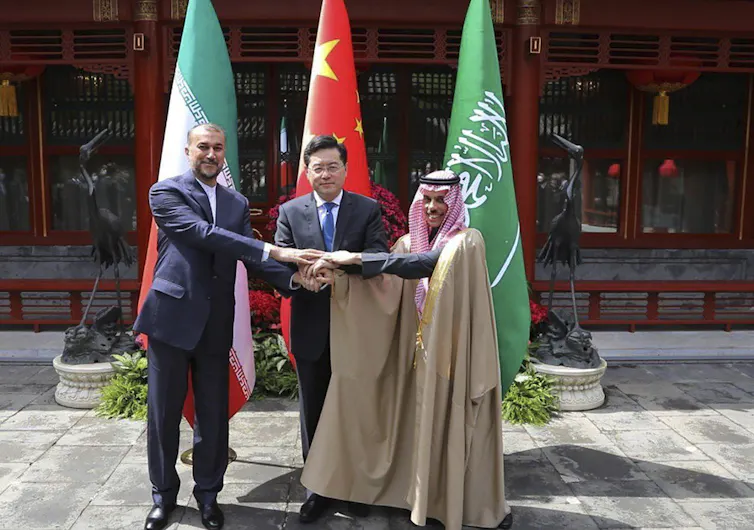
Iranian Foreign Ministry via AP
4. Lack of international management
Trump’s willingness to abandon talks to go to war, and the contradictory rhetoric he has employed all through the Iran battle, has weakened the notion of the U.S. as an trustworthy dealer.
That gives a large mushy energy increase for Beijing. It was China that pressed Iran to just accept the 14-day ceasefire proposal brokered by Pakistan. Certainly, China has slowly chipped away at America’s longtime standing as international mediator of first resort.
Beijing has successfully mediated prior to now between Iran and Saudi Arabia, and it attempted to do the same with Russia and Ukraine and Israel and the Palestinians.
Usually, the Iran struggle provides weight to Beijing’s worldview that the U.S.-led liberal international order is over. Even when China benefited at some degree from the struggle persevering with, its resolution to assist dealer the ceasefire exhibits that China is more and more taking over the mantle of world management that the U.S. used to personal.
And for Russia, the Iran struggle and the rupture between Trump and America’s NATO allies over their lack of help for it, shift world consideration and U.S. involvement from the struggle in Ukraine.